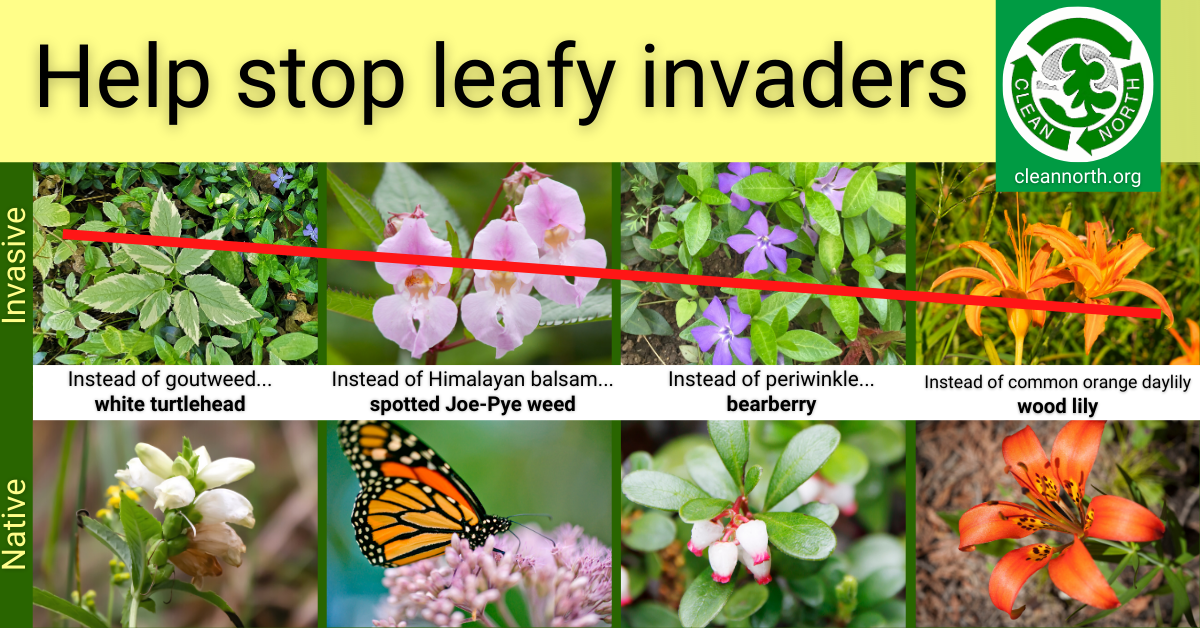
Check out the Sault/Algoma Grow Me Instead Guide
for a list of locally concerning invasives as well as native/pollinator plant alternatives
First up: Let’s talk about yard waste dumping…
We get into the nitty-gritty of invasive plants below, but up front we wanted to highlight a key way we can reduce the impacts of invasive plants on ecosystems: Not dumping yard waste in natural areas—including grass clippings and raked leaves. This type of dumping has become a serious issue here in Sault Ste. Marie, as well as in many urban natural areas across Canada. It may seem harmless but it’s not. It can:
- Smother or slow the growth of native plants
- Spread invasive plants, which can grow from seeds or pieces of root or stem in the pile
- Allow invasive plants to outcompete native ones, reducing biodiversity and harming wildlife
- Introduce pests and diseases to natural areas
- Add excess nutrients to soil and water, changing chemistry and encouraging weed growth
- Pose a fire hazard
- Block trails and waterways
Clean North, the City of Sault Ste. Marie, the Sault Naturalists, and the Invasive Species Centre are working on signs to be posted in local natural areas to educate people about why dumping yard waste is harmful. Here’s how you should dispose of yard waste:
- Non-invasive plant material: Place fallen leaves, grass clippings, and non-invasive plant material in paper leaf bags and set them out for the city to collect (more info on municipal yard waste collection).
- Invasive plant material (including stems, flowerheads, seeds, roots): Place in a black plastic trash bag and solarize it (leave it in the sun for two weeks), then put it in the trash (exception: Japanese knotweed).
What is an invasive plant?
One that is not native to our area and causes harm to the environment, the economy, and/or society. They cause harm when they:
- Take over garden beds, crowding out valued perennials
- Escape into natural areas, crowding out native plants and reducing food and habitat available to bees, butterflies, other insects, and birds and other wildlife
- Reduce insect populations—for example, invasive trap plants can lure butterflies to lay their eggs on the invasive rather than the true host plant that hatching caterpillars need to survive
- Suppress the next generation of trees
- Reduce abundance of wild food like mushrooms and berries
- Affect hiking and hunting by forming thickets that are difficult to walk through—some (like buckthorn) can retain green leaves long into the fall, impairing visibility
- Take over shoreline areas, changing water levels, affecting boating and other recreational activities, reducing habitat for aquatic creatures, and increasing the risk of flooding nearby homes
- Cause home and property owners, municipalities, parks, farmers, etc. to rack up huge costs to manage these plants
- Affect human health
For example:
- Environmental harm:
- The crowns of invasive Norway maples are ecological dead ends: Birds fly in and then fly right back out again because there’s nothing for them to eat. In natural areas overtaken by Norway maple, the understory may be barren or support only highly aggressive invasives.
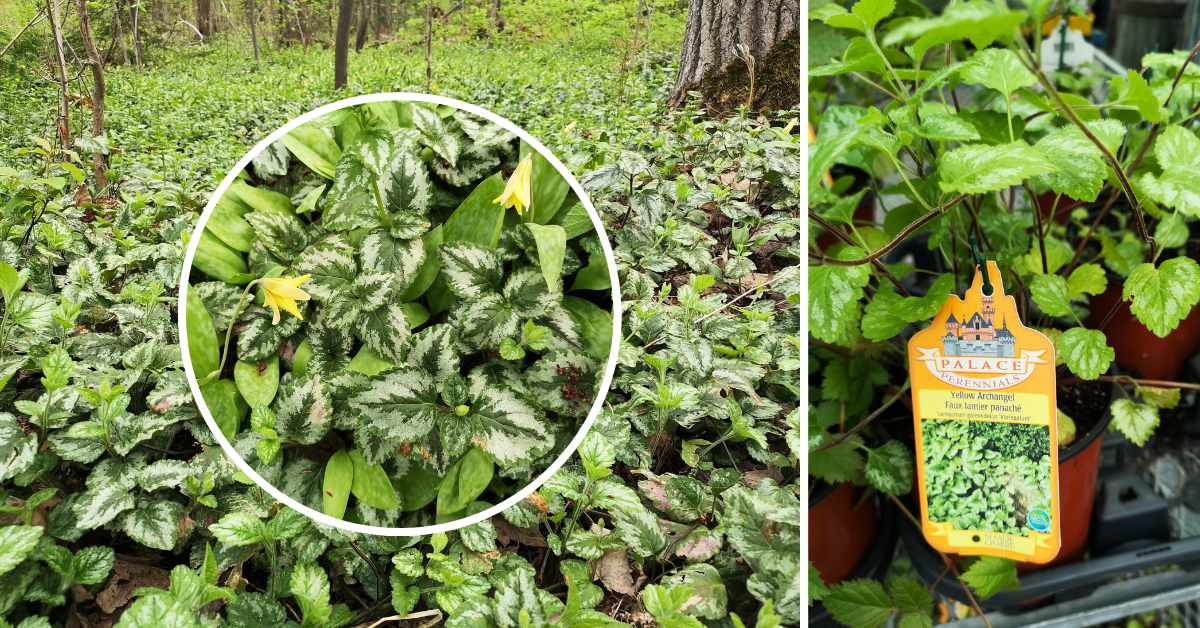
- Periwinkle, lily of the valley, goutweed, English ivy, and yellow archangel are invasive groundcovers that can crowd out native understory plants, causing natives to fade away and disrupting the ecosystem. Invasive shrubs like Tatarian honeysuckle, burning bush, multiflora rose, Japanese barberry, and buckthorn can crowd out native shrubs but do not offer our wild creatures the same food and habitat support.
- Economic harm:
- Japanese knotweed can cause economic harm by forming thick, difficult-to-control thickets and including sending runners up through holes in the pavement and into foundations.
- Phragmites can completely cover shoreline areas, making navigation impossible and affecting fishing.
- Canada thistle can run rampant on farms and be costly for farmers to control.
- Societal harm:
- Japanese barberry creates an environment in which the ticks that carry Lyme disease thrive.
- The sap of giant hogweed and wild parsnip can harm your health by burning your skin—the sap of the former can even cause blindness.
- The bright-red berries of bittersweet nightshade are tempting to children but toxic.
Click here for a list of invasive garden plants
Why remove invasive plants?
Because doing so will help prevent harm to our natural areas, our wildlife, our economy, and ourselves. It’s the right thing to do! In many parts of southern Ontario, invasive plants are wreaking massive havoc. We are in better shape here in the Sault/Algoma, but invasive plants are making inroads here, too. If you walk into any natural area in the Sault, you will see a boatload of invasive plant species. It’s less costly to stop the problem now rather than letting it become as widespread as it is down south.
“But I can control my invasive garden plants!”
This is magical thinking. The data show us that invasive species will outfox us. Plus you won’t always own your property. The next owners might know nothing about invasive species and might give away or sell ones you left behind. How invasive plants spread:
- Few/no natural predators
- In some cases, greening up early/staying green late into the fall, giving them an energy boost native plants don’t get
- Roots/rhizomes spreading into nearby properties and natural areas
- Intentional planting/sharing
- Mowing, cutting, or soil movement spreading seeds/plant parts
- People dumping yard waste in natural areas
- Seeds/plant parts gone with the wind or carried by water (including being washed into the sewer system)
- Seeds/plant parts clinging to animals, people, vehicles, boats, ATVs, machinery
- Birds or other wildlife eating seeds and pooping them out elsewhere
- Heavy rain flooding ornamental ponds and washing invasive pond plants into nearby waterways
- Dumping of aquariums in nature
It makes no sense to hang onto invasive plants when you can choose from many native/non-invasive alternatives. And you can have a spectacular garden without invasives. Check out our Sault/Algoma Grow Me Instead Guide.
If we who garden love nature (as most if not all of us would say we do), then we should strive to have minimal impact on ecosystems and the creatures that depend on them. Take the Gardener’s Oath:
“I will do no harm to ecosystems or people.”
How can you tackle leafy invaders on your property?
Note: If you have Japanese knotweed on your property, please read this post before attempting to control it. And take special care with garlic mustard—we recommend you follow the Invasive Species Centre guidelines here.
Removing invasive plants can range from fairly straightforward to complicated, expensive, and time consuming. It depends on what a species’ quirks and characteristics are, how large the plant/patch is, and how long it’s been growing in that location.
Given how many invasive plants there are, it’s a challenge to provide detailed information on best methods for each. If you are not careful, you can do more harm than good. For example, trying to dig out Japanese knotweed can trigger this species’ incredibly resilient and persistent root system to shoot out many feet in every direction.
Research before planting
Before you buy or accept a new plant, confirm that it’s not invasive (Canadian invasive plant lists and our invasive plant list). Check several sources, and if a species is considered invasive in Michigan or southern Ontario, please don’t grow it here. We are behind on the invasion timeline compared with many other jurisdictions, but that doesn’t mean we are immune. For example, you may never have seen Japanese barberry or burning bush invading a local natural area, but both these species are wreaking havoc in Michigan and southern Ontario and other northern jurisdictions.
It’s way cheaper and easier to prevent invasive species from taking hold than it is to manage them after they become established.

Above is a simplified version of the plant invasion curve. It shows that prevention is cheapest; that control is most effective and cheaper before runaway spread has occurred in an area; that by the time the public becomes aware of the problem, control is already difficult and getting expensive; and that it takes way too long for governments to ban the sale of invasive plants.
When shopping for plants, keep in mind that it’s still legal for garden centres to sell many invasive plants. Also, garden centre staff may not know which are invasive, so confirm invasive status via at least two reliable online sources. Be wary of plants marketed as “jeepers creepers” or “vigorous ground covers” (goutweed, periwinkle, creeping Jenny, English ivy, carpet bugle, yellow archangel, etc.)—they are often invasive.
How to get started: Inventory plants in your yard
Determine which are invasive and which you would like to tackle first. Consider starting with the worst invasive or the most troublesome infestation. If you have limited resources, attacking a smaller patch/easier-to-remove species might be a good place to start.
Removal tactics
Deciding how to remove invasive garden plants is tricky. Not all tactics work for all species, and some can make things worse. For example, if you mow, dig, or tarp an established patch of Japanese knotweed, it will likely respond by extending its root system, with new patches popping up elsewhere on your property.
We recommend consulting several sources for each species to see what the state of knowledge is—but keep in mind that there are reputable agencies dispensing bad advice. For example, it’s not rare to see agencies recommending tarping Japanese knotweed to kill the root system (see photo of a knotweed tarping fail below; photo by Hannah Hudson). One agency we find trustworthy is the Invasive Species Council of Metro Vancouver.

A key tactic for removing any unwanted plants, whether invasive or just weedy, is to wait for moist soil conditions to reduce root breakage. Either wait until after a heavy rain or water the area well.
Another key tip is to check out Facebook groups dedicated to specific species, such as the Goutweed Support Group, the Creeping Bellflower Battles group, or the Japanese Knotweed – Canadian Support Group.
With invasive spring bulbs (star of Bethlehem and scilla), as soon as they bloom in spring, dig them up, making sure to get the main bulb as well as any small bulblets. Secure in a black plastic trash bag, solarize in the sun for two weeks, then put in the trash. You may need to repeat this for a few or even several years.
With Himalayan balsam, pulling works wonders. This invasive is an annual with shallow roots, so it pulls easily. Ideally, get at this species in July before its exploding seedheads form. Securely bag, solarize, put in the trash.

A Clean North volunteer pulling Himalayan balsam in a park in the west end of Sault Ste. Marie, Ontario.
With larger removal projects, decide if you want to remove high-value plants from the affected area. For example, if you have hostas growing in a patch of goutweed, you may choose to remove the hostas and plant them elsewhere before dealing with the goutweed. Before moving high-value plants, thoroughly wash all the soil off the roots to ensure no bits of goutweed roots hitch a ride. With some invasive species, a small piece of root or even a bit of stem can start a new plant.
If you are attempting to dig out invasives, we recommend you first gently loosen soil layers using a hand or pitchfork oriented horizontally to the soil and ease removing plants and roots. Digging with a shovel or trowel increases the risk of root breakage.
Avoid tilling soil. This practice (including in vegetable gardens) is falling out of favour for several reasons, including that it breaks up invasive plant/weed roots—with a new plant potentially forming from each root bit. It also brings buried weed seeds up to where they may more readily germinate and degrades soil structure.
With some species, once soil is loosened, you can gently pull out plants including the roots, but this won’t work for all. Again…read recommendations on several reputable websites to determine what seems to work best (or visit an associated Facebook group).
With other species, especially larger plants (including invasive trees/shrubs), it may be helpful to use a special tool designed to lift invasives out by the roots (check out Pullerbear, a Canadian manufacturer).
After removing as much invasive plant material as possible, consider sifting the soil to ensure all root fragments are removed. You can make your own soil sifter that can be set into a wheelbarrow.
Make sure soil from the site with invasive plants doesn’t get moved elsewhere in your yard or get washed into the sewer system.
Dispose of invasive plant material (flowers, seedheads, stems, leaves, roots) responsibly:
- Seal it in a black plastic trash bag, solarize it for a few weeks, put in the trash.
- Do not compost it.
- Do not put it in a lawn waste bag for the city to collect.
- Do not dump it (or any lawn/garden waste) in a natural area.
Japanese knotweed material requires special care. Join the Japanese Knotweed – Canadian Support Group on Facebook for more info.
Consider tarping for some invasive plants. One of our volunteers successful killed a patch of goutweed by tarping it for two years. She sourced a free tarp from a marina (discarded boat shrinkwrap), then covered the goutweed patch for two years. It appears to have killed all the goutweed. However, it likely helped that this patch was surrounded by an asphalt path and a driveway, so the roots had nowhere to go.
Buckthorn is another one that can be smothered—cut it the height of a coffee can, then nail a coffee can over the stump to starve it of light (make sure there is zero light getting inside the can). You can also try Buckthorn baggies. Planting a high density native plants can also help prevent buckthorn from returning.
Be sure to monitor for regrowth of invasive species, and nip new sprouts in the bud.
Plant other vigorous (ideally native/pollinator) plants to fill in the space (nature abhors a vacuum and will often fill it with undesirable plants):
- Some native/pollinator plant choices for shade: Goatsbeard, black cohosh, Canada anemone, foamflower, large white trillium, ferns, large-leaved aster, native violets, wild ginger.
- Some vigorous native/pollinator plant choices for sun: Oxeye sunflower, golden Alexander, swamp milkweed, wild bee balm, spotted Joe-Pye weed, common boneset, pearly everlasting, blue vervain, northern blue flag iris, blue false indigo.
- Some non-natives that do well in the presence of invasives: Peonies, daylily cultivars (not common orange daylily—it’s invasive), hostas, lungworts, and English primroses.
What if you can’t manage a full-scale assault?
Most important: Make sure invasive plants do not flower/go to seed—remove flowers/seedheads, bag them, solarize them, and throw them in the trash.
With some species, you can try stressing the plant: Avoid watering it or cut stems at ground level and put a bin, bucket, or box over it to starve it of light and moisture. But check at least two reputable sources before doing this because with some invasive species, disturbing but not fully removing the plant is worse than leaving it alone.
You can also dig a trench around a patch of invasives to limit spread by roots, especially if the invasive is coming in from a neighbour’s yard. This won’t work for all species but can be especially helpful with shallow-rooted groundcovers. Be cautious about digging under a tree or near other high-value plants or you might damage their roots as well.
Other helpful practices
- Don’t move plants from home to cottage or vice versa—invasive roots/seeds may be hiding in the soil
- When sharing plants with friends, consider sharing them “bare root” (wash all the soil off before potting/moving)
- Clean boots before and after hiking to avoid moving invasive seeds or plant parts to a new location
- Place ornamental ponds well away from lakes, rivers, and streams (flooding can carry invasive aquatic plants into natural water bodies)
- Never dump aquariums outside or in natural water bodies—seal unwanted aquarium plants in a plastic bag and throw in the trash
To help fight invasive plants on a broader scale, consider becoming a supporter of the Canadian Coalition for Invasive Plant Regulation.
What about chemical herbicides?
Most uses of chemical herbicides are illegal in Ontario, including residential cosmetic use—for example, people using 2,4-D to kill lawn weeds. This restriction makes sense because lawn/garden chemicals pose risks to people, wildlife and pets (including increased risk of cancer in dogs).
However, the invasive plant problem is not cosmetic—these plants can cause massive harm to ecosystems, the economy, and society. While we strongly encourage people to use non-chemical means of controlling unwanted plants whenever possible, we also recognize that in some cases, herbicides are the only realistic option. Some examples: Japanese knotweed, phragmites, giant hogweed.
You can buy herbicides at hardware and lumber stores, but they are generally locked up and sold only to people who have a poison ivy problem. It’s frustrating that the provincial government has deemed Japanese knotweed to be illegal to own, buy, or distribute but they do not make it easy to access the only method known to be effective in controlling it. They want you to hire a licensed pesticide applicator, but those can be difficult to find in northern Ontario, not to mention expensive.
You may have seen posts about homemade herbicide alternatives on social media. However, the Ministry of Environment has asked Master Gardeners to stop recommending these as they have not been tested for safety and effectiveness. The substances they contain (vinegar, dish soap, salt, etc.) contain harsh chemicals that can kill beneficial plants and insects as well as weeds and can degrade soil.
“An invasive species is creeping into my yard from a neighbour’s yard. What can I do?”
If you have a good relationship with your neighbour, you can try to convince them to remove the invasive or allow you to remove it. Unfortunately, many people still resist the idea that some plants can cause major harm. If getting the neighbour to act is not feasible, your best bet is a barrier:
- Build a “defensive” row of vigorous native/non-invasive plants along your property line to bar invading species. Make sure they are close together so there’s little space for invasives to slip through. Some great choices for shade: Black cohosh, goatsbeard, hostas, lungworts, large white trillium, Canada anemone, large-leaved aster. For sun: Golden Alexander, Siberian iris, Culver’s root, New England aster, black-eyed Susan, purple coneflower, pearly everlasting, blue vervain, daylily cultivars, peonies.
- Dig a trench along the property line to limit root spread. You can also dig a trench and then insert/bury flat rocks on end in a row along the property line to act as a barrier. We don’t recommend burying anything plastic in the ground (including landscaping cloth) to avoid contaminating soil with microplastics and chemicals. Landscaping cloth is fragile and often ends up as a shredded mess in garden beds.
Click here for a list of plants considered invasive in Ontario
Click here for the Sault/Algoma Grow Me Instead Guide
Where can you get native/pollinator plants?
- Garden centres sometimes carry native/pollinator plants—before buying, always doublecheck native status via a reliable online source. And keep in mind that nativars (cultivated varieties of native plants) tend to be less useful to pollinators.
- You can also order from online sellers such as Ontario Native Plants or try growing from seed from outfits like Northern Wildflowers (check out our post on growing your own native plants through winter sowing). Here is a list of Ontario native plant sellers but most are in southern Ontario.
How to choose what native plants to grow
Are all non-native plants bad?
We encourage growing native plants because they best support our pollinators and other wildlife. But many non-natives do no harm. Just Google before buying. And bear in mind that not all garden centre staff are knowledgeable about which plants are invasive/native. Sadly, some garden centres still sell invasive species like goutweed, periwinkle, lily of the valley, English ivy, yellow archangel, Japanese barberry, burning bush, and Norway maple.
Partners in/supporters of the Clean North Invasive Plant Species Education Project
- Sault Naturalists (especially Valerie Walker and Peter Burtch)
- Kensington Conservancy
- Sault College School of Natural Environment
- Sault Ste. Marie Region Conservation Authority
- City of Sault Ste. Marie
- Lake Superior Watershed Conservancy
- Bruce Station, St. Joseph Island, and Sault Ste. Marie horticultural societies
- Seedy Saturday Algoma
- Algoma Master Gardeners
- Johnson Farmers Market
Special thanks to the Invasive Species Centre and to the Bruce Station Horticultural Society for providing funding for our work.
Want to know more?
Contact us at info@cleannorth.org.
Learn about the link between invasive Japanese barberry and Lyme disease