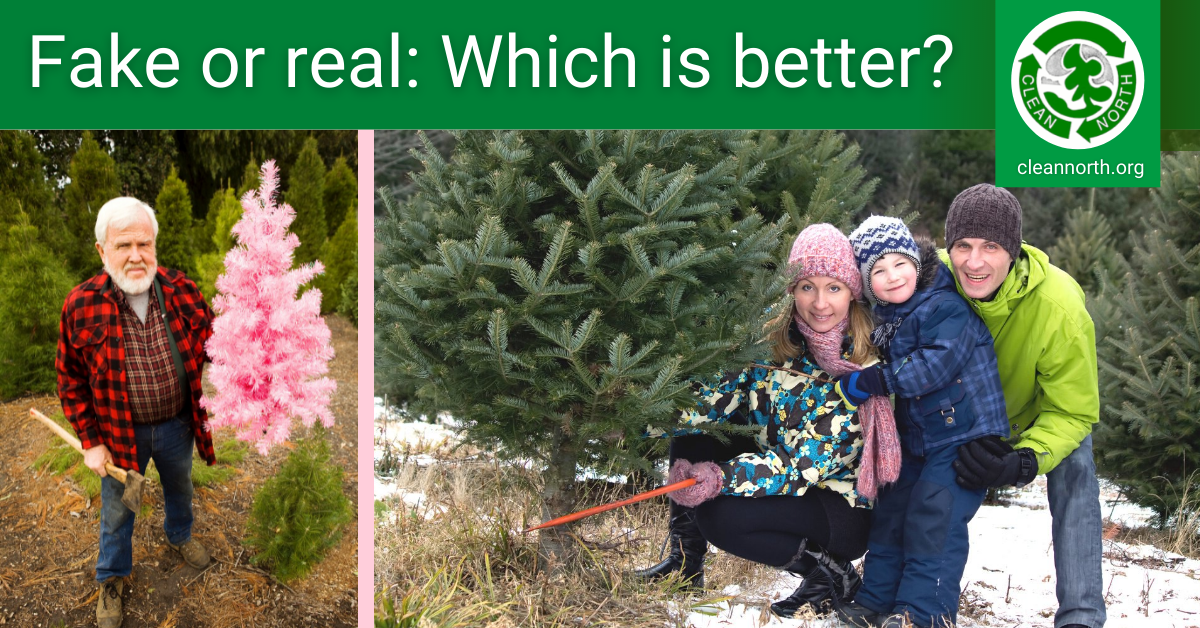
Every holiday season, people ask us: “Is it more ‘green’ to buy a real Christmas tree or an artificial one?” The answer is…it depends. But if you buy a local natural tree and then after Christmas donate it to us to chip into mulch, that’s generally the greenest option.
At Clean North, our goal is to help households across northern Ontario make informed, low-waste choices that protect our forests, waterways, and wildlife. So here’s a clear, updated guide to help you decide what tree is best for your home and for the planet.
🎄 Real Christmas Trees
A renewable, local, biodegradable choice: Real Christmas trees sold at stores are not taken from wild forests—they’re grown on farms as a crop. While growing, they absorb carbon, provide wildlife habitat, and help maintain open green spaces that might otherwise be developed.
Environmental advantages
- Renewable and compostable: Real trees break down naturally when mulched or composted.
- Supports local growers: Buying from nearby farms reduces transportation emissions and helps keep the local economy strong.
- Provides environmental benefits while growing: Tree farms act as temporary carbon sinks and help stabilize soil.
Environmental considerations
- Pesticide and fertilizer use: These vary by farm and region.
- Transportation footprint: A tree shipped a long distance has a higher carbon cost.
- Landfill problems: As with any organic matter (food scraps, paper, etc.), a real tree decomposes anaerobically in a landfill and can release methane—a potent greenhouse gas. Fortunately the days of natural Christmas trees ending up in our local landfill are over. Generally people either cut them up and use them as kindling, set them in their yard to be wildlife habitat till spring, or give them to us to chip into mulch.
How to make a real tree greener
- Choose local growers or farms with organic or low-chemical practices or cut your own on Crown land.
- Avoid landfill disposal—stick in your yard for wildlife habitat, cut up and compost, or donate to Clean North for chipping into mulch
🎄 Artificial Christmas Trees
Long-lasting, convenient, stable—but rooted in plastic: Artificial trees are typically made from PVC and metal, materials that require a lot of energy to produce and don’t break down at end of life. Most are manufactured overseas, which adds to their initial carbon footprint. Plus some may contain toxic chemicals or heavy metals, and it may be difficult to determine what’s in an artificial tree. Still, an artificial tree can be a low-impact choice if it’s used for many years.
Environmental advantages
- Durable, reusable: Long lifespan if stored carefully.
- Predictable size and shape: No shedding, watering, or annual transport.
- Convenience: Some come with lights already attached, reducing the annoyance of stringing lights.
Environmental considerations
- Possible presence of toxic chemicals and heavy metals: And it may be difficult to find out exactly what your tree is made of.
- High upfront carbon footprint: Manufacturing requires fossil fuels.
- Not recyclable: Nearly all end up in the landfill.
- Needs long-term use: To reduce its environmental impact, an artificial tree should be used 5–10+ years.
How to make an artificial tree greener
- Keep it as long as possible—ideally, longer than a decade.
- Donate or sell your tree if you switch styles.
- Consider buying secondhand to avoid new plastic production.
♻️ So… Which Is Better?
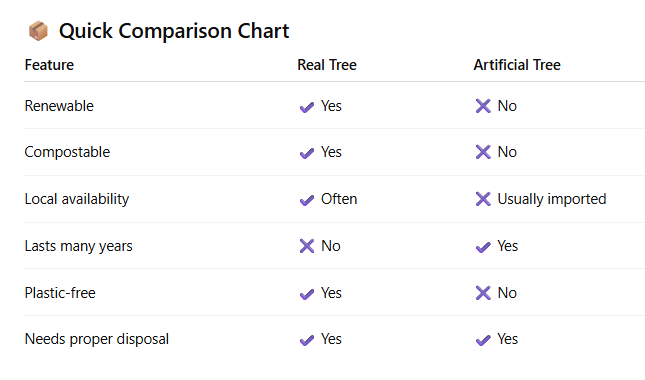
A locally grown real tree that’s composted or chipped into mulch is often the greener choice.
An artificial tree used for 10+ years can also be environmentally reasonable.
What matters most is:
- how far the tree traveled
- what it’s made from
- how long you use it
- whether it ends up in landfill
The greenest tree is the one you keep out of landfill and make the most of.
Good luck with your decision!
And remember, if you choose a real tree, bring it to Cambrian Mall (Rome’s end) after Christmas, and we’ll chip it into garden mulch. We give the mulch away in late spring.
Need help getting your tree to the mall? Watch our Facebook/Instagram pages for details of our tree pickup service, a partnership with Just Junk.
Questions? Email us at info@cleannorth.org.